This Is Not Not A Love Song
If you can accept "a bunch of love poems" as made holy by inclusion in scripture, some amazing things happen
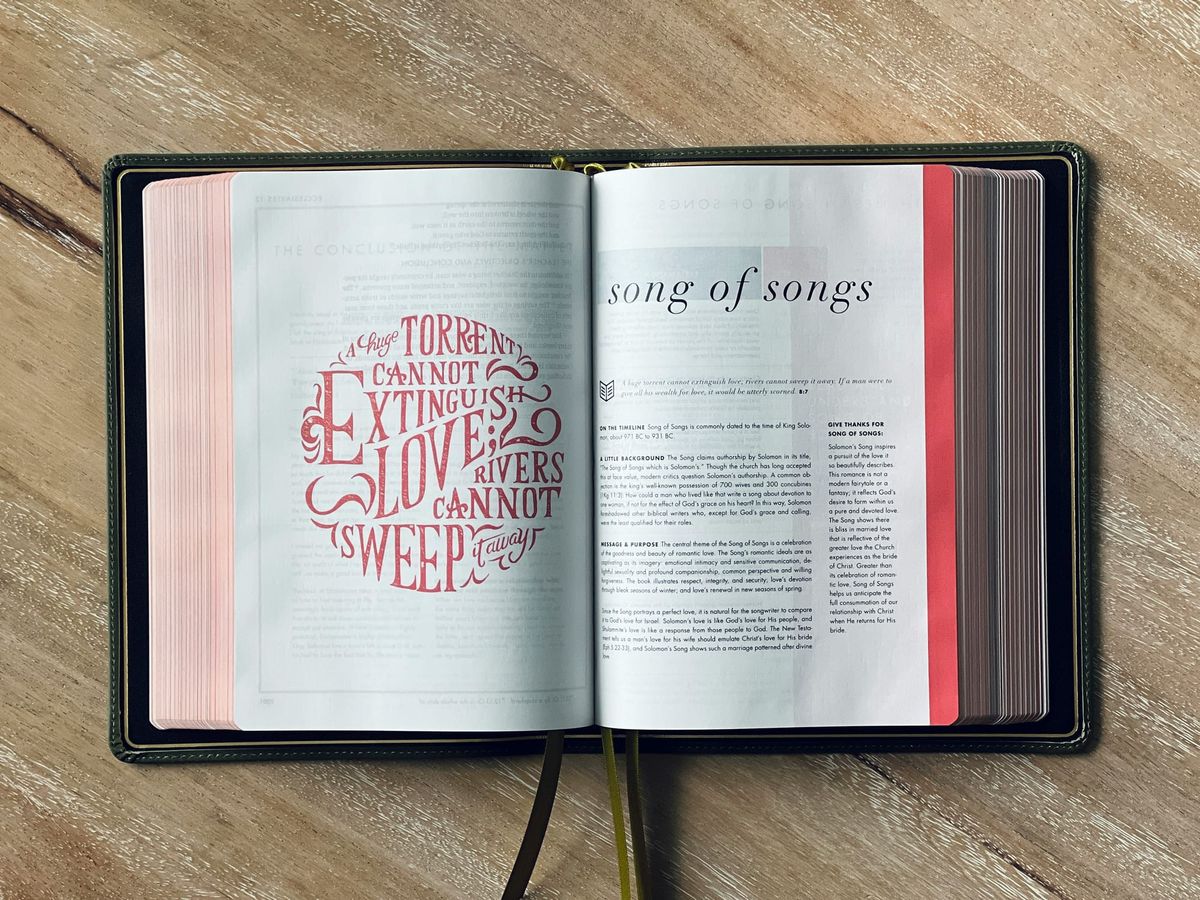
Let me set the scene for you. When we were first married, my wife and I lived in Eastern Pennsylvania, on a block of what they called "side by sides," small brick duplexes set very close to one another. It was seriously tight quarters, the kind of place where everybody knew what the neighbors were up to.
Two or three doors down from us was a family of Mom, Dad, two little kids and a teenage niece living with them for reasons we never did uncover. According to our next-door neighbors, the family kept this niece home from school to watch the kids and help around the house.
I have no idea if that was true or not, but she — Ada — was a sweet but dim kind of kid, who had somehow acquired a boyfriend named Jimmy who was also sweet, but even dimmer than Ada.
The aunt and uncle decided to break up this relationship, again for unknown reasons, leading to remarkable scenes where the boyfriend would show up on the sidewalk bellowing like a teenage Stanley Kowalski "ADA!" And she would lean up against the screen in her bedroom yelling back "JIMMY!"
I am sorry to report that my wife and I would laugh at these episodes, mostly because we ourselves were young and easily entertained. We weren't laughing at the young couple, but mostly just at how ridiculous and over-the-top it all was. Melodrama in Lancaster, PA! Who knew?
Great story, bro, but what does it have to do with anything?
By this point you may be thinking "Great story, bro, but what does it have to do with the Fourth of July, or scripture?" Well, my friend: the answer to the first part is that on this momentous weekend in the life of our nation, I felt it important to touch back on scripture for guidance and reassurance. I speak, of course of the marriage of Taylor Swift and Travis Kelce.
Why, was there something else going on this weekend?
As for what this has to do with scripture: funny you should ask! People have been asking what the Song of Solomon has to do with scripture for thousands of years, since even before it made it into the Hebrew or Greek bibles.
These poems resemble nothing so much as ancient erotic poetry, including racy songs about the weddings of pagan gods
After all, along with the Book of Ruth, this is one of only two books in the Bible not to mention "God" or "The Lord." It was probably written centuries after the time of Solomon, and it resembles nothing so much as ancient erotic poetry, including racy songs about the weddings of pagan gods.
I should also mention that the Song of Solomon has no plot. It's just a bunch of love poems, jammed together. They're very nice poems, but there's no overall message that anyone can discern.
Take the excerpt we read today. The first two verses are in the female voice of the book, the Ada of the Song of Solomon. She recalls a visit from her Jimmy, who leaps upon the mountains and bounds over the hills in his eagerness to see her, pressing up against her window.
The second part of the reading is in Jimmy's voice, calling on his lover to come away with him, because spring has arrived and life returned to the land.
And...that's pretty much it. That's the passage in a nutshell. So we have to ask again: What the hecker-decker? Why is this thing in the Bible, and why would anyone bother to preach on it?
According to the commentaries, our two basic choices for interpreting the passage, and the entire Song of Solomon. We can read it as an allegory, that is, as a poem that reveals hidden meaning in its symbolism. That's in fact why it made it into scripture. Jewish readers thought the poetry symbolized the love of God for the people of Israel. Christians, meanwhile, thought it was an allegory for the love of Christ and the church.
In other words, ancient readers disregarded the surface meaning in favor of deeper symbolism. That approach does have some things going for it. It was the way most people in those days read scripture, for one thing. For another, there are other parts of the Bible that are allegories, as far as anyone can tell.
I didn't look into Christian allegorical readings of this passage, but I did find some beautiful Jewish interpretations. For example, the great scholar Malbim says of the lover bounding over mountains and hills, "the Presence of [God's] strength exists beyond the worlds." That is, God's love for Israel is stronger than even the rules of physics. Others say that the lover's instruction to "Arise, my love, my fair one and come away" recalls God's call to the Israelites to "Rise up" when they took flight from Egypt, because that "the winter is past" means their exile is over.
There's a whole bunch more ways of interpreting the symbolism, much of which gets more complicated than can be easily summarized. And honestly some of it gets pretty silly after a while. One Islamic scholar said the book should be called not the Song of Songs but the "Folly of Follies, for it is a silly discourse which makes no sense, and no one among [the Jews] knows its meaning." Ouch.
Spring is here, flowers are blooming, turtledoves are singing, life is great
But I think you get the general drift. The male lover is God, the female lover is us, spring is here, flowers are blooming, turtledoves are singing, life is great.
But there is another way to interpret this passage, and the whole book, which is as straight-up love poetry, and pretty great love poetry at that. Ancient readers didn't deny the surface meaning, and were pretty clear that sacred or not, the poetry was worth preservation.
Today, most scholars are agreed that there really is no hidden meaning here. It is what it says it is: a bunch of love poems. But if you can accept "a bunch of love poems" as made holy by inclusion in scripture, some amazing things happen.
First, it becomes a blessing on our physical bodies: the Ada of poetry includes some fairly frank descriptions of her own body, for example. And because she insists on her dark complexion, saying "I am black but comely," we can add a blessing specifically on the bodies of dark-skinned women, which are too often despised in our own society, just as they seem to have been when the poems were originally composed.
Going further, we can say that the Song of Solomon sanctifies romantic love, even erotic love, sex and sexuality. Until the age of the Enlightenment, you must understand, sexuality was not understood as being primarily about what people did with their naughty bits. It was instead how one reached out beyond the self, to connect to others, including God. (Part that did not go in the sermon: this is why it's not uncommon to see depictions of saints in the throes of ecstasy in prayer. They weren't getting hornt up for God, they were feeling the connection, so to speak.)
Taking this love poetry, these silly little love songs, as scripture returns that holistic understanding of sexuality. It allows us to encounter and to embrace sexuality without shame or guilt, and that is all I am going to say about that.
Placing these poems in scripture implicitly validates those of us who long for, and are separated from, the loves of their lives.
Last, there is a kind of paradoxical blessing offered on those without romantic love in their lives. As I read the passage, I thought of the many widows I know, who have lost husbands of forty, fifty, sixty, sometimes even more years. Placing these poems in scripture implicitly validates those of us who long for, and are separated from, the loves of their lives.
But most of all, the Song of Solomon points us to a truth best expressed by one of the commentaries I consulted: "The devotion and commitment of one who is deeply loved have the power to infuse great purpose and meaning into a lover's life." (That's Texts for Preaching Volume B, in case anyone cares.)
When we are loved, deeply loved, crazy loved, loved beyond all sense or reason simply for who we are, it opens to us the gates of compassion and gives our lives shape and direction. Because God is, we are. Because God loves us, we love one another — and that loving is our reason for being.
When we answer God's call to us to "Arise, my loves, my beautiful ones, and come away," amazing things result. God's love for us and our love for God give birth to the love that powers the world.
Not too long after we got married, Ada ran away with Jimmy. We bumped into her a couple of years later. She told us they were married, and already had several children together. As far as I know, as far as I want to know, they are still deeply in love with one another, perhaps expecting their first grandchild.
Amazing things come of love!