What The Magi Knew
How do we live a life true to ourselves and true to the God who speaks to us through the stories of scripture?
As a preacher, I am very much committed to the goal of "making the Word strange again."[1] That is to say, I am committed to allowing scripture to speak to us in a way that is different and separate from us, uncertain, unpredictable, that raises more questions than it answers.
Some people talk about wanting to "re-enchant" scripture, which means to go beyond rational reductions of its message to rediscover its strangeness, its otherness, the meaning it has to offer our own lives and the life of the world. To do that, to find the sense of purpose, direction and moral imperative that we are offered in scripture, we need to find ways to read the Bible that have some grounding in the text itself — we can't just make up its meaning out of whole cloth — and that are not simply representations of our own thoughts, desires, and self-understanding.
Forgive me for spending a bit of time on interpretative theory. I think it helps to understand why finding unfamiliar ways of reading scripture is such a necessary and difficult project in the year of our Lord two thousand and twenty-five. (Well, that and I get bored.) Nowhere is that project more necessary and more difficult than in our "Christmas" and Easter stories, which we have all heard a thousand times, and which are by now so familiar that they can fly by without our suspecting that there may be more to them than meets the eye.
Whatever you might call these gentlemen, they don't come upon the baby Jesus in a stable surrounded by shepherds and angels.
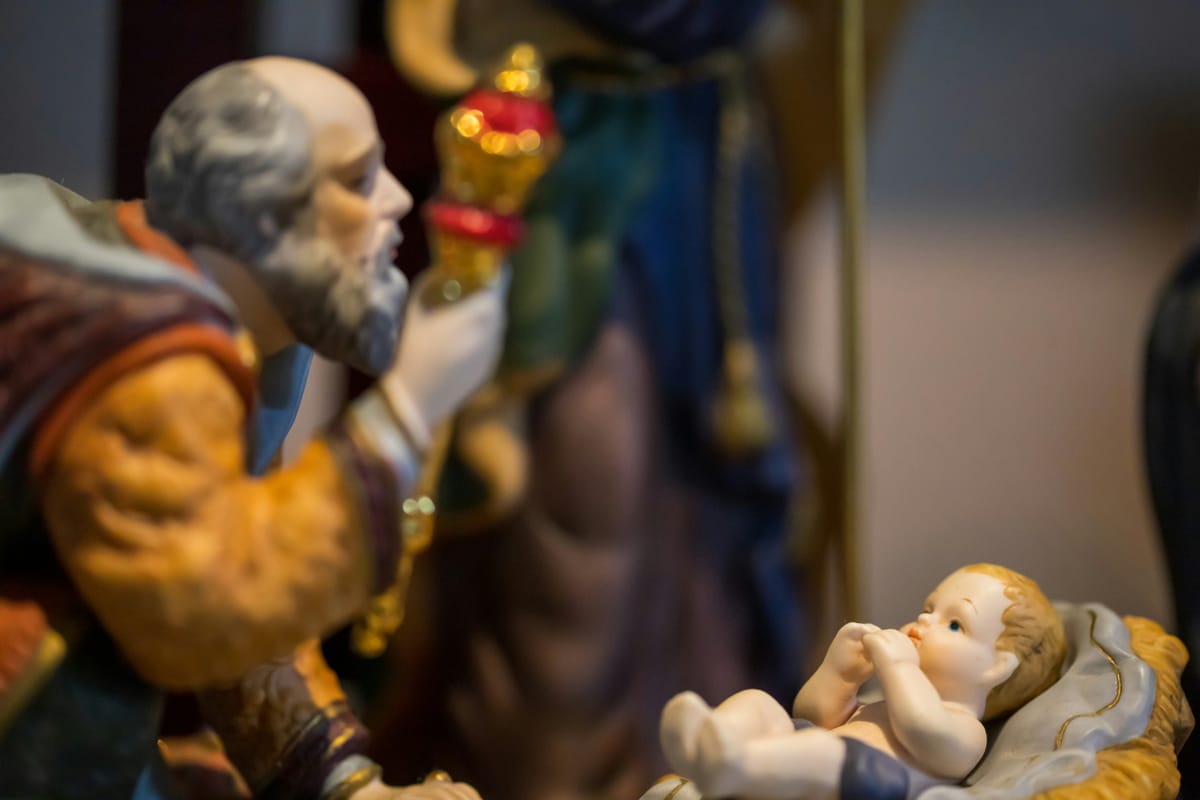
For example! Did you notice that there are not three kings who come to visit the newborn Jesus. We're not told how many of them there are — tradition says three because of the three gifts mentioned — we are not told their names, and they are not kings. "Astrologers" is probably the closest translation for Magi, without all the baggage that term has acquired in our society. Whatever you might call these gentlemen, they don't come upon the baby Jesus in a stable surrounded by shepherds and angels. That's mostly from Luke.
(Having said that, yes, I am aware that I just told everyone that their Christmas pageants and nativity sets are completely wrong. Leave it alone, as long as you don't have Santa kneeling at the manger, it's accurate enough for hand grenades and horseshoes, I say.)
In any case, there's the arbitrary, "made-up" kind of understanding we have to get past. I am sorry to say in all honesty that details like this often start in tradition, and are now maintained in order to sell things like nativity sets or other sentimental visions of the first Noel. And while there is nothing wrong in itself with owning a Nativity set or having sweet feelings about Christmas, or saying "Aww..." when you see the kids dressed up as shepherds and Wise Men, I think you can understand how these things are not the same as living a life true to ourselves and true to the God who speaks to us through the stories of scripture.
So if this story is not about three kings coming to pay homage to Jesus, what is it about? Most likely, the important part is the contrast between King Herod and King Jesus. Matthew is always eager to point out how Jesus is both continuous with Jewish tradition and different from it. Without getting bogged down in the details, Matthew's depiction of Jesus in many ways parallels the early life of Moses, Judaism's original savior, and of course it's two pieces of Jewish scripture run together that direct the Magi to Jesus in the end.
At the same time, Matthew is at some pains to make sure his readers know that Jesus will not grow up to be a king like David. He certainly will not be one like Herod, who was notorious for his ruthlessness, his ambition, and his brutality. Whether or not the massacre of the infants in Bethlehem was a historical event (it probably was not), Herod certainly had no problems with slaughtering those who might present a threat to his rule, up to and including his wife and three of his sons. It is also not beside the point that Herod came to power in the midst of a civil war, and was kept in power by the Romans largely because he was willing to wage wars to maintain the boundaries of the Roman empire.
It's fair to draw a contrast between Jesus the Prince of Peace, Herod the self-interested warmonger, and any other earthly kings who might be tempted to imitate him.
It's certainly fair, then, or responsible to the text, to draw a contrast between Jesus the Prince of Peace, Herod the self-interested warmonger, and any other earthly kings who might be tempted to imitate him, if you catch my drift. In fact, given the news from Venezuela, I'm sure there will be many sermons this morning doing just that.
So, yes, a fair contrast to make, and one that has been made many times through the course of history. It does risk being a projection of our own agenda. Karl Barth famously said that we ought to preach with the Bible in one hand and the newspaper in other, which does not mean what happens in today's newspaper is the only lens we need to hear the word of God.
Instead, I want to borrow the language of the philosopher Charles Taylor to suggest that we must recognize "certain demands on us, which are firmly anchored in our being-in-the-world."[2] In Christian terms, God expects us to be the people of God, based on and responding to the world we live in. For Christians, to understand who we are meant to be in the world means to understand first who Christ is. And it is here that we finally come to the strange, ungovernable and mystery-filled message of this text.
Because as awful as Herod is, he acts pretty rationally for an authoritarian leader. Tyrants always want to be strong, want to be in control, to be decisive, to eliminate threats before they can even emerge. A rival ruler might be popping up? Snuff him out, now, even if you have to kill a lot of other babies in the process. That's what it means to be king, after all. You have to do those things, otherwise people will think they can dominate you, just like you've been dominating them. Paradoxically, the stronger you try to be, the more you have to worry about being weak. Herod was "troubled" to hear about Jesus, Matthew tells us, disturbed, terrified.
Jesus by contrast, is, well, a baby. Maybe he's a toddler by this point, trips across the desert on camel-back take some time, after all. Babies don't want to be strong, or in control, or decisive.[3] They want to be warm, well-fed and well-loved. They don't go out and take what they want, they receive it passively. Babies, in other words, are weak, they are frail, and they are dependent. They are the definition of vulnerable, in other words.
And that is who the Magi are bowing down to as king. They're not paying homage to his future sacrifice on the cross, or the salvation it offers, or his future exaltation in heaven. That's all stuff we the readers know. They don't. They're worshiping a kid, probably still in diapers, probably still being carried around and fed by his parents.
You want to know who King Jesus is? He's a lot more like the infants murdered by Herod than like Herod himself. Kid wouldn't know what to do with a sword if you gave him one.
Wait, the star of heaven is pointing to that kid?
You want to know what the real gift of the story is? Despite the gold, frankincense and myrrh, it is the very vulnerability of this child in whom God has chosen to take flesh in the world. Another paradox: God becomes most different from us precisely when he becomes most like us. Because when God chooses to be vulnerable, he defeats all of our projections and all of the details we make up in order to have the story make sense.
Here is God, here is the king, in this child, in this place, in this time, far removed from anywhere we would expect to find him and anything like we would expect him to be.
(Wait, the star of heaven is pointing to that kid? Are you sure?)
In Jesus' specificity, his difference and his vulnerability, there is a freedom far more powerful than the control and certainty of the tyrant. Imagine a world in which you didn't have to worry about living strong or protecting yourself. Imagine not having to be like everyone else in strength and self-protection. I once met a man who carried around a pistol at all times to protect himself from "bandits," and I felt so sorry for him and the anxiety-ridden world he must live in. I also felt sorry for his family because of how his troubled nature made them all miserable, which is not quite beside the point of what I'm getting at here.
Imagine just being free to be yourself here and now, to live a life driven by the meaning and purpose God has set out before you.
I could probably preach a hundred more sermons on what it means to do that. I have, however, bored you enough for one day. The questions raised by the radical freedom of God and how we are meant to live it out will have to slip into the category of mystery for now.
I will say only this, since we will be celebrating communion this morning. The deepest mystery of all the gospel is that the same child, the same king, we read about in today's lesson found his meaning and purpose in offering up his broken body and poured-out blood for us. To be like him is the certain demand of God. It is who we are meant to be in the world. It is the source of deep and never-resolving mystery, as I say. And as the Magi knew, it is also the wellspring of deep and never-ending joy.[4]
- I want to say this is a quote from Stanley Hauerwas, but online searches are useless these days. Anyone know? ↩︎
- To be clear, I'm bending Taylor's meaning for my own purposes: he has no religious message. ↩︎
- I may be underestimating the extent to which babies can be assholes. ↩︎
- The NRSV says the Magi "rejoice" when they meet Jesus, which undersells the Greek. Literally, the text says "they rejoiced with exceeding joy." They are beside themselves with joy. ↩︎